What the Free Pallet Actually Costs: An Honest Accounting of In-Kind Donations
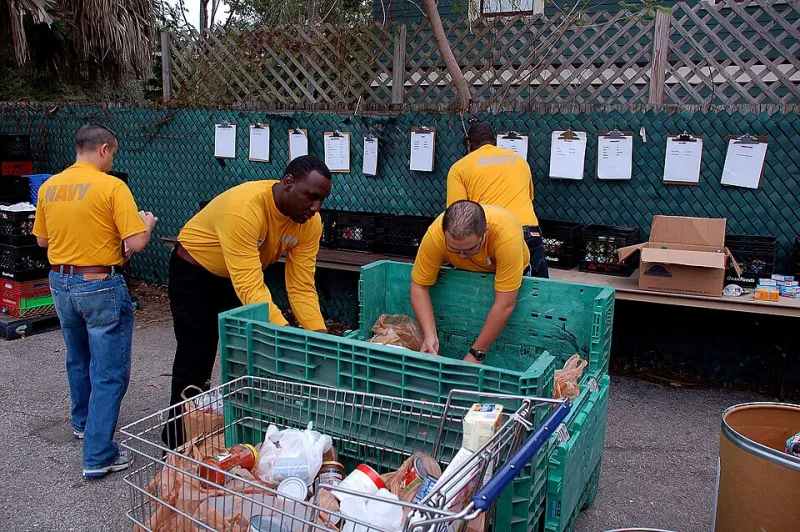
Photo: U.S. Navy photo by Mass Communication Specialist 1st Class Ruben Perez, Public domain, via Wikimedia Commons
There is a particular kind of exhaustion that comes from standing in a church parking lot at 4:45 on a Friday afternoon, watching a pickup truck unload seventeen garbage bags of clothing that no one asked for, knowing that the volunteers who would have spent the evening on outreach will instead spend it sorting stained sweaters into piles. No one wants to seem ungrateful. That is precisely what makes in-kind donation so difficult to govern.
Let's be direct: donated goods are not free. They carry costs that fall almost entirely on the organization receiving them, and disproportionately on the smallest organizations serving the communities with the least margin. The following is an honest accounting.
1. Storage Is Rent You Didn't Budget For
A donated pallet of canned goods occupies square footage that could hold a classroom, a food pantry's client-choice shelves, or a confidential meeting space. In a market where community organizations already struggle to afford their leases, every closet converted into a sorting room is a silent subsidy the donor has extracted from the mission.
2. Sorting Is Labor, and Labor Is the Scarcest Resource
Goods arrive unsorted, unsized, and frequently unsaleable. Someone must open every bag, check every expiration date, wash every item that can be washed, discard what cannot be used, and fold what remains. That work is either paid—an expense—or unpaid, which means it is taken from volunteers who could be doing something only a human presence can do: greeting people at the door, translating, following up on benefits applications.
3. Disposal Is a Cost You Inherit
Organizations routinely pay tipping fees to haul away donations they could not use. Torn clothing, expired food, broken furniture, and items so worn that no one would choose them become the recipient's waste problem. The donor receives a receipt; the organization receives a dumpster invoice.
4. Valuation Distorts the Ledger
In-kind gifts are recorded at fair market value, which can make an organization's financial statements look healthier than its cash position. A $40,000 in-kind line item may represent goods worth far less to the mission than $4,000 in unrestricted cash would have been. Boards reading the summary see generosity; the operations director sees a storage crisis.
5. Sorting Rooms Reproduce the Power They Claim to Dismantle
There is a reason so many organizations are moving toward client-choice models. A table of pre-bagged goods, selected by someone else, tells a family what they are presumed to need. A shelf where a parent chooses their own child's coat treats them as a decision-maker. The first model is easier to run with donated volume. The second is better for dignity. The two are frequently in tension.
6. Unsolicited Goods Generate Unpaid Emotional Labor
Turning away a donor's offering requires tact, and doing it well requires the same staff member, over and over, to absorb disappointment without causing offense. Multiply that across a year and it becomes a real personnel cost—one that never appears on a budget.
7. Volume Rewards the Wrong Things
When an organization's public image depends on accepting whatever arrives, it develops an incentive to accept more than it can use. Warehouses fill with items the community did not ask for, while the actual stated need—cash assistance, rental deposits, gas cards, interpretation—goes unmet.
8. Aged Inventory Becomes a Second Mission
Some organizations find themselves running a de facto thrift operation they never intended to launch, with staff time spent on retail logistics rather than on the work their charter describes. This is mission drift by accumulation, and it rarely gets a board vote.
What a Better Donation Policy Looks Like
The remedy is not ingratitude. It is clarity, written down, published before the truck arrives.
Publish a donation policy. State what you accept, in what condition, on what days, and through what channel. Specify that drop-offs are by appointment only. Post it prominently on your website and hand it to every prospective donor who calls.
Lead with cash first, always. Frame monetary giving as the most useful form of support, then explain why in concrete terms: a dollar buys exactly what a family needs, in the quantity needed, without a sorting room.
Maintain a live wish list. Replace open-ended goods appeals with specific, time-bound requests: forty twin sheet sets by March, ten microwaves for a rehousing program. This channels generosity into supply your operations can actually absorb.
Build referral partnerships. Establish relationships with thrift stores, textile recyclers, and furniture banks that can accept what you cannot. Give donors a warm handoff rather than a rejection. Many will thank you for the clarity.
Budget in-kind handling explicitly. If you accept goods, cost the labor and storage. Assign a staff owner. Track hours. Present the number to your board and to donors—it is a persuasive argument for cash.
Protect the receiving side. Where volume is unavoidable, consider setting a modest handling fee for large unscheduled deliveries. It is not inhospitable; it is honest.
Saying No Without Losing the Person
The donor who shows up with bags of clothing is not an adversary. Most are acting on a genuine impulse to help, shaped by a charitable sector that has spent decades training people to equate giving goods with giving care. Changing that expectation is part of our work.
A short script helps: thank them, tell them exactly what your organization can use right now, name the cash equivalent, and offer a specific redirect. "We're not able to take clothing, but a $50 gift covers a family's laundry for a month, and the shelter on Fifth accepts coats on Tuesdays." That is a refusal that keeps the relationship.
In-kind generosity is a form of trust. Trust deserves a response that is honest about what it costs to receive—and honest about what the community has actually asked for.